The first generation raised on the feed is backing away from it
Pew's 2025 survey: 48% of US teens now say social media harms people their age — up from 32% — and almost half have already cut back on their own.
Ask an adult what teenagers think of social media and you’ll usually get some version of: they love it, they’re glued to it, they don’t know anything else. The first two might be true. The third is where it gets interesting.
In 2025, Pew Research Center published one of the most careful check-ins we have on this question — a survey of 1,391 American teens aged 13 to 17, run through a nationally representative panel. Pew has asked many of the same questions for years, which means we can see something rarer than a snapshot. We can see a turn.
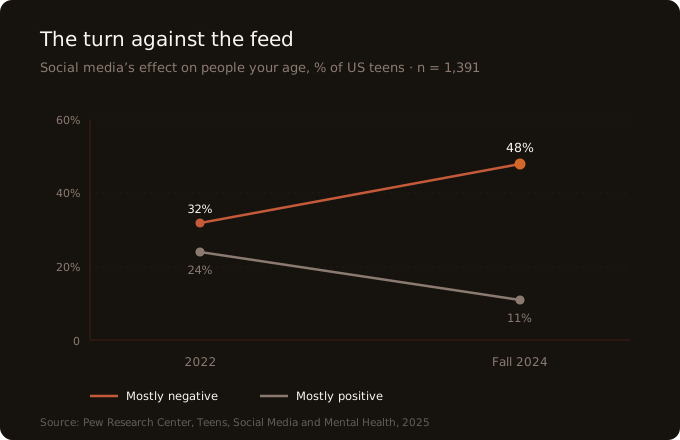
And it is a turn. Nearly half of teens — 48% — now say social media has a mostly negative effect on people their age. Three years earlier, that number was 32%. Over the same stretch, the share who call it mostly positive collapsed from 24% to 11%. The people who grew up entirely inside the feed, who never knew a before, are the ones souring on it fastest.
“Harmful — for everyone except me”
There’s a strange asymmetry inside those numbers, and it might be the most human finding in the whole report.
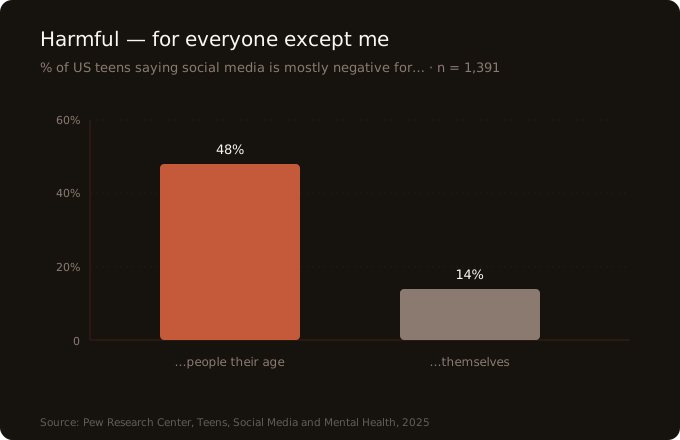
While 48% of teens say social media harms people their age, only 14% say it harms them personally. Same platforms, same hours, same pockets. The harm is always somewhere else — a thing that happens to other, less careful people.
Before we smile at that, it’s worth admitting the feeling is universal. Every adult scrolling at midnight believes, on some level, that they’re the exception too. That gap — clearly seeing the cost in general, quietly exempting yourself in particular — is a big part of how the hours survive. You don’t keep a habit because you think it’s good. You keep it because you think your version of it is fine.
Yet the details in Pew’s data suggest teens know more than the 14% lets on. When asked about specifics rather than the whole, the picture sharpens: 45% say social media hurts their sleep. 40% say it hurts their productivity. And 45% now flatly say they spend too much time on it — up from 36% in 2022.
The part nobody predicted: they’re acting on it
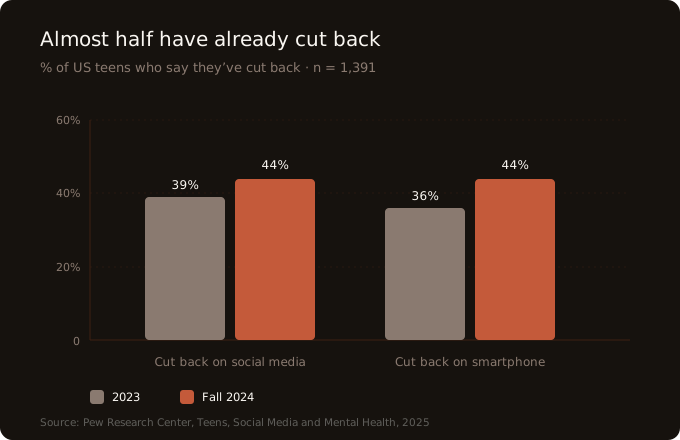
Here’s the number that turns this from a mood into a story. 44% of teens say they’ve cut back on social media — and the same share have cut back on their phones overall. Both figures are up from the year before. The group most likely to cut back? The teens who say they spend too much time. Noticing, it turns out, is where deciding starts.
The honest frame matters here. This is a survey — self-reported feelings and self-reported cutting back, not screen-time logs, and it can’t prove the platforms cause the harm teens attribute to them. Pew itself is careful to say the study surfaces perspectives, not causality. And the picture isn’t one-sided: 74% of teens say social media keeps them connected to their friends, and most describe its effect on them as neutral. This isn’t a generation in flight. It’s a generation doing the math.
But that’s exactly what makes it worth your attention. Nobody made these teens cut back. No ban did this — they’re deciding it themselves, one by one, from the inside of the most sophisticated attention machinery ever built. The first generation with no memory of a world before the feed looked at the trade and started renegotiating it.
The renegotiation is the hard part, of course — deciding to cut back is one skill, and holding that decision at 11pm is another. That second skill is the entire reason Pausa exists: you pick the number, and it keeps the number. But the first move belongs to the person, and almost half of the youngest people on these platforms have already made it.
If they can look at the feed with clear eyes, so can the rest of us.
Source: Faverio M, Anderson M, Park E. “Teens, Social Media and Mental Health.” Pew Research Center, April 2025. pewresearch.org